Showing posts with label Health. Show all posts

Friday, 3 May 2013

Case Study: British American Tobacco

Our goals are to grow our brands and the value of the business, to improve productivity and to embed the principles of corporate responsibility around the Group
Brands They Produce: Dunhill, Kent, Lucky Strike, Pall Mall, Bensons & Hedges etc

They have the dominant market share in: Canada, Australia, Brazil, South Africa, Pakistan, Norway and many more.


Manufacturing:

  • HQ in London
  • R&D in Southampton and Cambridge (university towns)
  • 52 Factories worldwide, plus 4 specific cigar factories

Tobacco Leaf Sourcing: 

  • Purchase 460,000 tonnes of tobacco leaves
  • 80% of the tobacco leaves are from emerging countries
  • The supply chain is made up of around 250,000 farmers
  • Tobacco leaves are produced under a 'Social Responsibilty in tobacco production programme

Global Brands Drive:

  • Trying not to be reliant on just USA and Western Europe as while there are high profit margins there is a decline in sales volume
  • Trying to break into emerging economies where volumes are set to rise like Indonesia, where lots of cheap tobacco is sold until a lot of people are addicted

An ethical approach means that shareholders, consumers and producers are happy. BUT there are some issues...

Developing Economies and Tobacco:

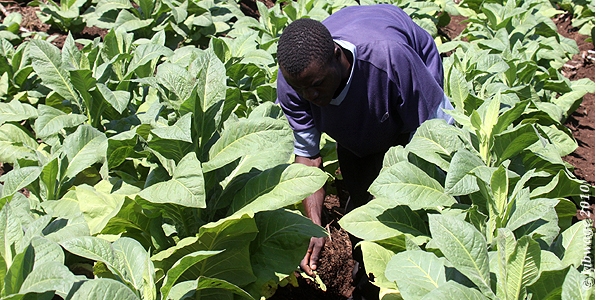
  • Largest agribusiness in Kenya, contracting over 17,000 farmers who work on 15,000 hectares.
  • In these regions food production had dropped dramatically
  • The danger is that tobacco cultivation will replace food crops
  • Tobacco sourced from the devloping world tends to be used to make less expensive brands - cigarrettes made from tobacco grown in Brazil cost half of ones with American tobacco
Developing economies and tobacco: 
  • Shift in production to LEDCs because of their lower labour costs, with many factories in South East Asia
  • Factories in places like Singapore and Kores are closer to destination markets
  • Closure of UK factories like one in Southampton
Marketing and Tobacco:
  • Harder to advertise cigarrettes in MEDCs due to advertising bans
  • Iincreased activity in NIC and LEDC markets as oppose to MEDCs, where it is declining in part due to health/social issues
BAT in India:

  • It is an emerging market
  • Around 5 million children under the age of 15 are addicted to tobacco
  • BAT are actively advertising to convert people, particularly the young, to cigarettes eg branded pop concerts, free samples
  • TNCs can now own factories outright in India


http://www.bat.com/

Tobacco TNCs

Brands: Camels, Malboro, Prince, More, Mayfair
TNCs: Phillip Morris International, China National Tobacco, Japan Tobacco International

(Not so fun) Facts:

  • 5 trillion cigarettes are produced per year globally
  • Tobacco is smoked by over 1 billion customers around the world every day
  • Around 6 million people die globally each year from smoking
  • Globally there are between 8,00 to 14,000 cigarettes produced every minute

CHINA:
China is the biggest market with 350 million smokers consuming 1800 billion cigarettes each year.

It accounts for 35% of the global market.

70% of chinese men smoke, but only 4% of women.

The industry in China is owned by the State.

The Chinese National Tobacco Company was worth $91.7 billion in 2010.

The Health Risks of Smoking:

  • Heart attacks and strokes - Smokers are 5x more likely to have a heart attack than non smokers
  • Cancer - Oral, throat, lung, cervical
  • Other lung problems like Emphysema

Friday, 19 April 2013

Case Study: US Health system and French Health System

USA: Free market health care provision 
  • Based on the principles of a free market economy
  • Extremely privatised
  • Most care providers are privately run organisations
  • There are a few federal, state, county and city run facilities
  • 65% of hospitals are privately run not-for profit organisations
  • Per Capita expenditure on health was US$6714 in 2006
  • One of the most expensive models in the world
  • Usually provided through health insurance with 64% of the population having some sort of medical insurance plan
  • Insurance is often paid for by employers as part of a salary package - the health insurance alone is around US$10,000 per year to an employee and their family
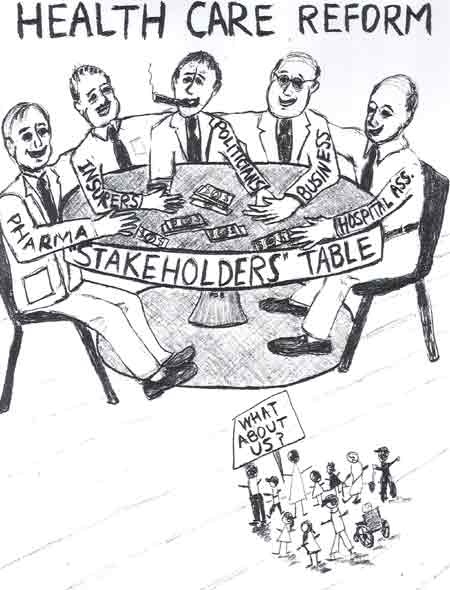
  • Health insurance companies operate to make a profit
  • Recently introduced some governmental support - all Americans over the age of 65 have access to Medicare
  • Medicaid provides basic state provided health care for the poorest people but not comprehensive cover - 14 million people still have no acces to healthcare
  • Around 15% of the US population (45 million) does not have any health insurance
France
  • Mainly funded by the government 
  • Administrated through a number of social insurance schemes
  • In 2004 80% of the population were covered by the main State regulated insurer
  • Individuals must pay a compulsory health insurance of 0.75% of their earnings which is deducted from their salary
  • Their employer then makes a 12.08% contribution
  • About 85% of the population also pay a voluntary top-up premium of 2.5% of their income to make sure all their health costs are fully reimbursed
  • Recently introduced a system of health coverage CMU so that those earning less than 6600 euros don't have to make any health insurance payments
  • Provided by general physicians
  • No restrictions on where doctors can set up their practises
  • Individuals have the choice of using more than one general physician
  • You can demand access to hospitals and specialist services without a referral from a general physician

Healthcare Systems

Emergent:

  • Healthcare viewed as an item of personal consumption
  • Physician operates as a solo entrepreneur
  • Professional associations are powerful
  • Private ownership of facilities
  • Direct payment of physicians
  • State's role in healthcare is minimal
  • Development of local health workers 
Eg, in India healthcare is highly diversified with both western and traditional practises operating.

Socialised:
  • Healthcare is a state-provided service
  • Physicians are state employed 
  • Professional associations are weak or non existenet
  • Facilities are wholly publicly owned
  • Payments for services are entirely indirect
  • State's role in healthcare is total
Cuba's health service is very effective, with the WHO ranking it just below the USA's despite the fact it spends 10x less. 

1 in 6 doctors in South Africa are Cuban partly because there are 21 medical schools providing free training.

Pluralistic:
  • Healthcare viewed as a consumer product 
  • Physician operates as a solo entrepreneur
  • Professional associations are powerful
  • Private and public ownership of facilities
  • State's role in healthcare is minimal and indirect
In the USA the health system is provided by thousands of independent doctor, clinics and pharmacies however the federal government recently introduced Medicaid and Medicare.

Insurance/social security:
  • Healthcare is an insured and guaranteed consumer product 
  • Physicians operate as social entrepreneurs and as members of strong professional associations
  • Private and public ownership of facilities
  • Payment for services mostly indirect
  • State's role in healthcare is evident but indirect
WHO judged the French healthcare system to be the most effective in the world, but it also very expensive accounting for 10% of France's GDP.

National Health Service:
  • Healthcare is a state supported service
  • Physicians operate as solo entrepreneurs and as members  
  • Facilities are mainly publicly owned 
  • State's role in healthcare is central and direct
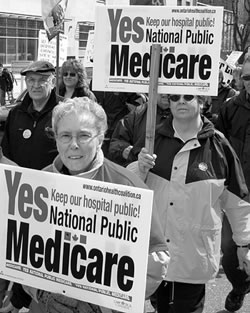
The only countries with national health care are the UK and Canada. Canada's aim is to provide its citizens with equal access to healthcare regardless of their ability to pay in a scheme known as Medicare.